August 2026
The Books We Keep Returning To

There are books we admire, books we recommend and books we remember.
Then there are the books we return to.
They occupy a different category entirely.
Rereading is a curious act because the book itself remains unchanged. The sentences sit exactly where they did before. The ending has not moved. The characters have not reconsidered their choices in our absence.
We have.
A book encountered at twenty can become a different book at thirty-five. A character once dismissed as weak begins to appear frightened. A romantic decision becomes selfish. A paragraph passed over entirely on the first reading suddenly seems to contain the whole book.
This is one of literature’s quietest pleasures: the discovery that a book can wait for us to catch up with it.
The books worth returning to are not necessarily the most complicated. Nor are they always the books we would call our favourites. They are books with enough space inside them for another reading — and another version of ourselves.
These are some of ours.

The Great Gatsby — F. Scott Fitzgerald
Few books suffer more from being remembered through their imagery.
The champagne glasses. The lawns. The cars. The parties. The green light across the water.
It is easy to reduce The Great Gatsby to its aesthetic, particularly now that its visual language has become shorthand for a certain kind of doomed glamour. But returning to the novel reveals something considerably colder.
The parties are lonely.
The wealth is anxious.
The romance at the centre of the book is less a love story than an attempt to reverse time.
Gatsby becomes more interesting with age precisely because his dream becomes less romantic. He has created an extraordinary life around the belief that if he arranges the present carefully enough, the past will eventually agree to return.
It will not.
On an early reading, this feels tragic.
Later, it can feel inevitable.
Fitzgerald’s achievement is that neither interpretation quite replaces the other.
The book remains beautiful because Gatsby’s delusion is beautiful. It remains devastating because beauty cannot make it true.
And every return to that final image — boats moving forward while being drawn backward — seems to acquire something from the years that have passed since we last read it.
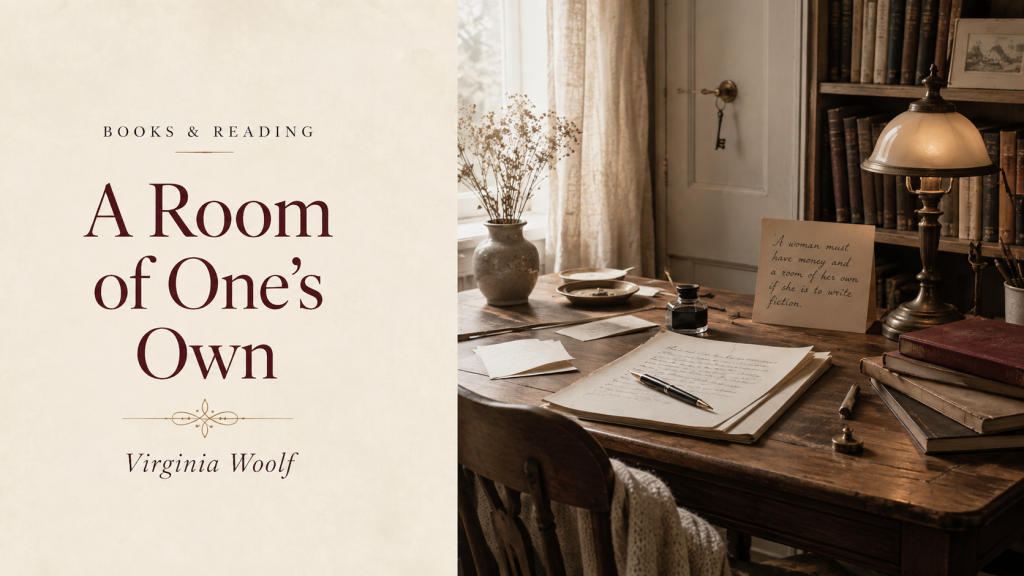
A Room of One’s Own — Virginia Woolf
Some books are returned to for their stories.
Others are returned to because their questions refuse to become historical.
Virginia Woolf’s A Room of One’s Own belongs to the latter category.
Its premise is famously simple: creative freedom requires material conditions. Space matters. Money matters. Time matters. Intellectual independence is difficult to achieve when one’s survival depends upon the approval of others.
But the enduring power of the essay lies in the way Woolf moves between those arguments.
She wanders.
Through colleges, libraries, imagined histories, meals, fictional women and literary tradition.
The structure itself seems to enact the freedom she is discussing.
On one reading, the essay is about women and literature.
On another, it is about the invisible architecture surrounding creative work.
Who gets uninterrupted time?
Who expects to be listened to?
Who is encouraged to take their own ideas seriously?
Who can afford to fail privately for years before producing something worth showing anybody?
The circumstances have changed considerably since Woolf delivered the lectures from which the essay emerged.
The questions have not disappeared.
That makes it one of those rare works of criticism that can become more relevant as the reader’s own relationship with work, ambition and independence develops.
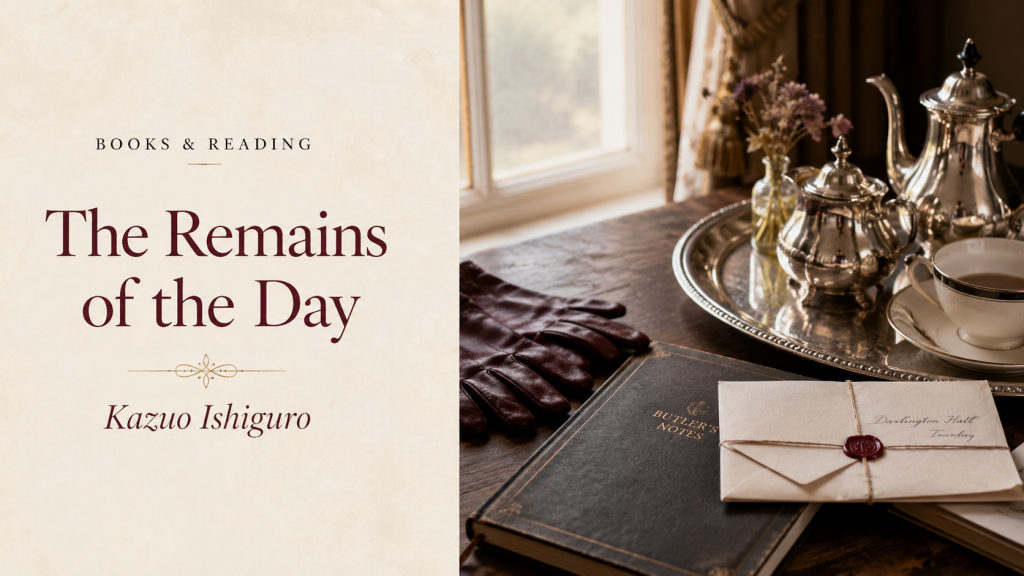
The Remains of the Day — Kazuo Ishiguro
There are books whose emotional force is obvious immediately.
The Remains of the Day is powerful for the opposite reason.
Almost everything important in it is withheld.
Stevens, an English butler looking back over his life, is committed to dignity, professionalism and service. His language is careful. His recollections are orderly. His emotional life appears, at first, to be similarly controlled.
The reader gradually understands that this control has cost him almost everything.
The novel becomes richer on rereading because we no longer depend on Stevens to tell us what is happening.
We know what he cannot say.
A conversation that once appeared polite becomes devastating. A professional decision reveals itself as moral evasion. Miss Kenton’s smallest gestures acquire significance because we already understand how little Stevens will allow himself to recognise.
The novel asks a difficult question without ever stating it crudely:
What happens when the identity we build to protect ourselves becomes the thing that prevents us from living?
Read young, Stevens can seem frustrating.
Read later, he is harder to judge.
We understand more about compromise, fear, pride and the lives people accidentally construct while believing they are simply making sensible decisions.
The tragedy is not that Stevens never had another life available to him.
It is that he almost did.
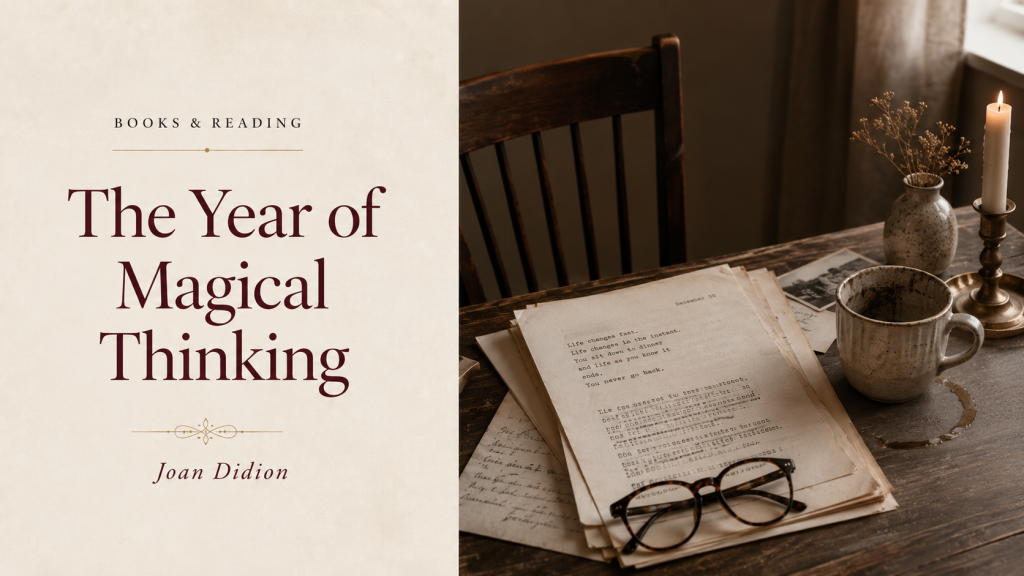
The Year of Magical Thinking — Joan Didion
Some books change because we change.
Others become different because life eventually gives us the experience required to understand them.
Joan Didion’s account of the year following the sudden death of her husband, John Gregory Dunne, is one of those books.
Its subject is grief, but its real interest is the mind’s refusal to accept what the body already knows.
Didion writes about continuing to behave as though the dead might return. About avoiding certain decisions because they would acknowledge finality. About the strange private logic grief constructs when ordinary logic is no longer sufficient.
The phrase “magical thinking” captures this beautifully.
It is not stupidity.
It is survival by temporary irrationality.
On a first reading, the precision of Didion’s prose is striking. On later readings, it is the gaps between those precise sentences that become more affecting.
She is attempting to impose order on something fundamentally disordering.
That tension gives the book its permanence.
It also prevents it from becoming sentimental.
Grief is not presented as transformation, wisdom or a journey neatly completed.
It is an alteration in reality.
The book becomes a companion not because it explains loss but because it refuses to simplify it.

Anna Karenina — Leo Tolstoy
The remarkable thing about returning to Anna Karenina is how frequently one’s loyalties change.
It is tempting to remember the novel primarily through Anna herself: the affair, the train, the social condemnation, the tragedy.
But Tolstoy builds something far wider.
Marriage, parenthood, desire, boredom, work, faith, vanity, jealousy, domestic happiness and the impossibility of knowing another person fully all sit beside one another.
Different sections become visible at different ages.
Anna may dominate an early reading.
Later, Dolly’s exhausted domestic life can become far more moving.
Levin’s anxieties about purpose and work suddenly feel less digressive and more central.
Karenin, initially easy to dislike, becomes stranger and more complicated.
Even minor social interactions begin to reveal an entire moral world.
The novel deepens because Tolstoy rarely allows anyone to remain entirely right or entirely wrong.
People behave badly and remain sympathetic.
They love one another and cause enormous harm.
They understand themselves imperfectly.
They want things that contradict other things they also want.
In other words, they continue to resemble people.
A great novel does not always reward rereading by revealing hidden clues.
Sometimes it rewards us by refusing to simplify human behaviour even after we know exactly what happens.

The Bell Jar — Sylvia Plath
Certain books are so closely associated with a period of life that returning to them can feel almost like opening a letter from a former self.
The Bell Jar is one of them.
Many readers first encounter Esther Greenwood young, when her uncertainty about ambition, identity and adulthood feels immediate.
She is intelligent and successful, yet paralysed by possibility.
Plath’s famous image of the fig tree captures this perfectly: each fig represents a different possible life, and choosing one appears to require allowing all the others to disappear.
For a young reader, the metaphor can feel like an articulation of anxiety.
Years later, it reads differently.
The impossibility of living every version of one’s life becomes less theoretical.
Choices have been made.
Some possibilities really have disappeared.
Others turned out not to matter.
The novel also changes when read beyond its reputation as a confessional text.
It is extraordinarily funny.
Sharp, observant, vain, cruel, absurd.
Esther notices everything.
That wit matters because it prevents the book from becoming a single emotional register.
Returning to The Bell Jar means encountering not only its darkness but its intelligence — and noticing how often the two exist in the same sentence.

The Lover — Marguerite Duras
Memory is rarely as orderly as autobiography pretends.
Marguerite Duras understood this.
The Lover moves through recollection in fragments: colonial Vietnam, family poverty, desire, shame, a ferry crossing, clothing, heat, a wealthy Chinese lover, the strange distances between mother and daughter.
The book does not feel remembered so much as continually remembered again.
This is why rereading it is particularly rewarding.
Images accumulate meaning.
A gold lamé shoe.
A man’s car.
A face observed from the future.
The voice moves between the girl who experienced these events and the older woman who understands that experience differently.
Neither perspective is entirely reliable.
That instability is the point.
Duras reminds us that memory is not an archive.
It is a form of authorship.
Every time we recall the past we arrange it again, emphasising certain images, omitting others, interpreting our former selves from a position they could never have understood.
On rereading, the book seems less like a story of an affair and more like an inquiry into possession.
Who owns a memory?
The person who lived it?
The person who later interprets it?
The person who finally writes it down?
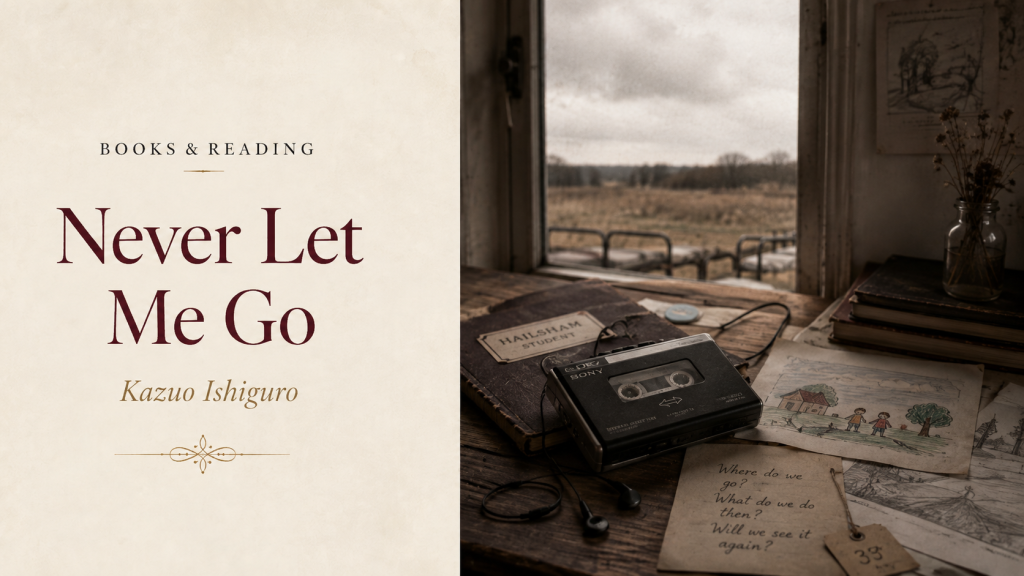
Never Let Me Go — Kazuo Ishiguro
The premise of Never Let Me Go becomes clear relatively early.
And strangely, knowing it makes the novel better.
Kathy, Ruth and Tommy grow up in a seemingly idyllic English boarding school, Hailsham. The quiet horror underlying their lives gradually becomes apparent: they have been created for organ donation.
But Ishiguro refuses to turn this into a conventional dystopian story.
There is no revolution.
No elaborate escape.
No heroic attempt to destroy the system.
Instead, his characters worry about friendships, jealousy, art, sex, misunderstandings and whether somebody once really loved them.
This can be frustrating on a first reading.
On rereading, it becomes the novel’s most disturbing idea.
Human beings are remarkably capable of accepting the world they inherit.
Even when that world is terrible.
We spend our lives inside structures we did not design, adjusting our expectations accordingly.
The speculative premise eventually begins to feel almost secondary.
The novel becomes about mortality itself.
All lives, after all, take place under a condition the characters cannot escape.
Their time is simply shorter and the mechanism more visible.
Once that parallel becomes apparent, the book becomes difficult to forget.
The Stranger — Albert Camus
There is a danger in meeting certain books too early.
They become symbols before they become texts.
The Stranger is often encountered alongside words such as absurdism, existentialism and alienation. The terminology can arrive before the experience of the novel itself.
Returning later allows the strangeness back in.
Meursault’s apparent indifference is unsettling not simply because he refuses conventional emotion, but because society appears more disturbed by his failure to perform grief correctly than by many of his actual actions.
The courtroom becomes less concerned with what happened than with what kind of person Meursault appears to be.
Did he cry at his mother’s funeral?
Did he drink coffee?
Did he begin a relationship too soon afterwards?
The trial turns into an evaluation of whether he has behaved recognisably enough to belong.
This makes the book unexpectedly contemporary.
We remain fascinated by the performance of appropriate emotion.
We still expect grief, remorse, love and outrage to appear in culturally legible forms.
Meursault refuses — or is unable — to provide them.
The result is a short novel that becomes stranger rather than more familiar with repetition.

To the Lighthouse — Virginia Woolf
The first time through To the Lighthouse, it is possible to wonder what exactly is happening.
On subsequent readings, that question becomes much less important.
The Ramsay family and their guests spend time together on the Isle of Skye. They plan a trip to a lighthouse. Conversations occur. A dinner is served. Years pass.
The traditional machinery of plot is remarkably quiet.
The real movement happens elsewhere.
Inside thought.
Between people.
Across time.
Woolf’s characters continually misunderstand one another while also, occasionally, experiencing flashes of almost perfect recognition.
Mrs Ramsay sees one version of her husband.
He experiences another.
Lily Briscoe tries to paint and wonders whether the work will matter.
Children observe adults without fully understanding the worlds that govern them.
And then time passes with startling indifference.
One of the great pleasures of rereading To the Lighthouse is discovering how much the book understands about the way ordinary moments later acquire significance.
A dinner can become a vanished world.
A room can preserve absence.
A person once taken for granted can become the centre of memory.
The novel grows more affecting as the reader develops their own catalogue of such moments.
Perhaps this is what all great rereading eventually reveals.
The book has not been waiting unchanged after all.
It has been gathering meaning somewhere outside itself.
In us.
Why return at all?
There is always another book to read.
This makes rereading feel almost extravagant.
Why spend ten hours with a story we already know when thousands remain unread?
Because knowing what happens is not the same as knowing a book.
The first reading is often dominated by momentum.
We want to know where the story is going.
Who survives.
Who leaves.
What the secret is.
How the argument ends.
Once that uncertainty disappears, something else becomes available.
Structure.
Language.
Silence.
Patterns we missed because we were moving too quickly.
A glance from a character whose significance we did not yet understand.
An image that appears on page twenty and quietly returns two hundred pages later.
The rereader is free from suspense.
That freedom creates attention.
But perhaps the strongest reason is simpler.
We reread because books become landmarks in our own lives.
Returning to one allows us to measure the distance travelled since the last time we were there.
The sentence has not changed.
We notice that we have.
That is why certain books never really become finished.
They wait on the shelf.
And every few years, they become new again.