August 2026
The Return of the Beautiful Book
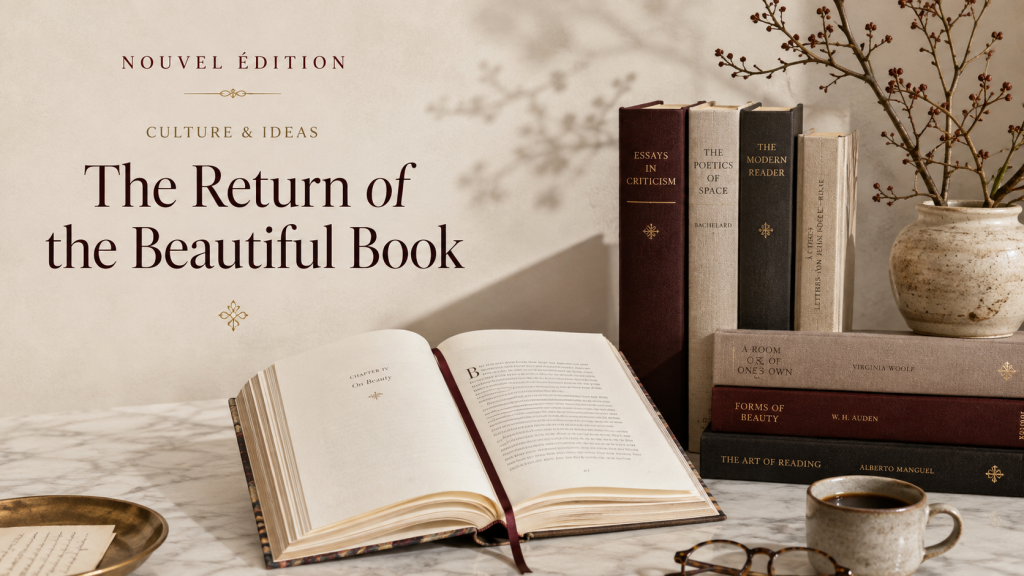
For a while, the future of reading seemed obvious.
Books would become lighter, faster and less physical. Entire libraries could live behind a sheet of glass. A novel could be bought at midnight and opened seconds later. Thousands of pages could travel inside a handbag without adding any real weight. The object itself, it appeared, might eventually become unnecessary.
And yet the physical book has not disappeared.
If anything, something more interesting has happened.
As reading has become increasingly digital, the printed book has become more deliberate. The books we choose to own are often more carefully made, more beautifully designed and more consciously kept. Covers are textured. Paper is considered. Typography is noticed. Special editions sell out. Readers photograph their shelves, collect particular imprints and search second-hand shops for editions they once borrowed or lost.
The book has survived technological convenience by becoming something convenience cannot entirely replace.
An object.
Not merely a container for words, but a physical expression of them.
The difference matters.
When almost everything became weightless
Much of contemporary life has been steadily dematerialised.
Photographs once lived in albums. Music arrived on records, tapes and CDs. Newspapers accumulated on kitchen tables. Letters waited in drawers. Tickets became souvenirs almost accidentally, folded into books or left inside coat pockets long after the event itself had passed.
Now many of these things exist primarily as files, subscriptions, feeds and accounts.
This has made life immeasurably easier.
It has also changed our relationship with possession.
A photograph stored somewhere among twenty thousand others does not occupy the same psychological space as one printed and framed. A playlist containing every song we have ever liked asks something different of us than the small stack of records we chose to buy.
Abundance changes attention.
When everything is available, selection becomes meaningful.
Perhaps this is part of the reason the physical book has acquired a different kind of value. We no longer need to own every book we read. An e-reader can carry hundreds. Audiobooks accompany commutes and flights. Digital libraries allow access without accumulation.
The book we decide to place on a shelf, then, has survived a small act of selection.
We have chosen to give it space.
That choice transforms the object.
The physical library has always revealed something about its owner, but perhaps it does so even more clearly now. A shelf is no longer simply evidence of what someone has read. It is increasingly a record of what they considered worth keeping.
Some books remain because they were loved.
Some because they were difficult.
Some because they belong to a particular version of our lives.
There are novels we associate permanently with the room in which we first read them. Books carried through airports, marked by sand or rain, filled with receipts and boarding passes. Books given by people who are no longer present. Books bought before we knew whether we would like them because the cover itself seemed to make some sort of promise.
Digital books can contain the same words.
They cannot accumulate quite the same history.
Design is not decoration
A beautifully made book does more than make a shelf attractive.
Its design shapes the reading before the first sentence has properly begun.
The weight of the cover. The texture beneath the fingers. The width of the margins. The density of the type. The shade of the paper. Whether a chapter begins immediately or is allowed to arrive alone on a fresh page.
These decisions are easy to overlook precisely because the best book design rarely announces itself.
It creates atmosphere quietly.
Typography determines more than legibility. A page set with generous leading feels different from one arranged tightly. A serif can make a text appear authoritative, contemporary, historical, intimate or austere before the reader has consciously registered why. Small changes in scale, spacing and proportion alter the rhythm with which the eye encounters language.
Paper does something similar.
Bright white stock can make certain books feel sharp and modern. Creamier paper softens the page. Uncoated paper absorbs light rather than throwing it back toward the reader. A heavy stock turns even the act of moving between pages into something slower and more deliberate.
None of this changes the words.
And yet all of it changes the experience of them.
Publishing has always occupied this unusual territory between literature and manufacturing. A manuscript begins as language but eventually becomes an object that must be measured in millimetres, grams and paper weights. Someone must decide where the title sits. Someone must choose the space between one line and the next. Someone must determine how the spine looks when the book is closed and only two centimetres of it are visible on a shelf.
These may appear to be secondary decisions.
They are not.
A book is one of the rare cultural objects in which the container and the content remain in sustained physical contact. We hold the design for hours while encountering the work.
The object mediates the reading.
This is why the most memorable book covers rarely feel arbitrary. They do not simply illustrate a plot. They establish a world around the book. They suggest temperature, era, restraint, strangeness, seriousness or humour.
Sometimes the cover only makes complete sense after the book has been read.
Those are often the best ones.
We are buying fewer objects — and asking more of them
There is a contradiction running through contemporary consumer culture.
We live among extraordinary abundance, yet many people are becoming more selective about what they want permanently around them.
The language of interiors increasingly revolves around editing. Wardrobes are curated. Kitchens are simplified. Objects are expected to earn their place. Even in homes that contain plenty, there is often an aspiration toward intentionality.
Books fit naturally into this shift because they are unusually good at being both useful and beautiful.
A row of books changes a room in a way a folder of digital files cannot.
Not because shelves automatically make someone interesting, and certainly not because books should become props. Their appeal is deeper than that.
Books carry evidence of inner life into physical space.
They suggest time spent elsewhere.
A painting can tell us something about someone’s taste. A chair can reveal their relationship with design. Books introduce ideas, obsessions, periods of curiosity, old ambitions and unfinished interests.
A shelf may contain the novel someone read at university beside the cookbook they bought in Rome. A monograph on architecture beside a battered paperback crime novel. Poetry that has hardly been opened beside a memoir that has been reread five times.
The contradictions are part of what make private libraries interesting.
They evolve rather than being completed.
This may also explain the renewed appeal of beautifully produced editions.
If a reader is going to own a book rather than simply access it, the physical form begins to matter more.
The paperback bought for a flight may serve one purpose. The clothbound edition bought years later because the book became important serves another.
We do not necessarily need both.
But collecting has never been entirely about need.
The new collectability
For centuries, books have been collected as rare objects: first editions, signed copies, fine bindings, limited printings and unusual provenance.
What feels notable now is how ordinary readers have adopted a gentler version of the same instinct.
They collect editions.
A particular publisher’s classics. A cover series by a certain designer. Vintage paperbacks from a specific decade. Small press titles. Books with deckled edges. Matching hardbacks. Japanese editions whose typography they cannot read but whose design they admire.
Some search for a single childhood book with the cover they remember.
Others replace inexpensive editions of favourite novels with ones they expect to keep permanently.
The motivation is not always financial value.
Often it is simply continuity.
A beautiful edition acknowledges that reading can extend beyond consumption.
Most contemporary culture arrives, is experienced and is quickly replaced. Another episode begins automatically. Another article appears beneath the one we just finished. Another song is suggested before the current one has ended.
Books resist this rhythm surprisingly well.
They can wait.
An unread book can remain on a shelf for ten years without becoming obsolete. A novel can disappear from our attention and return decades later with entirely different meaning. An inscription written in 1987 can suddenly matter to someone who was not alive when it was written.
The physical book accommodates time differently.
It ages.
Corners soften. Jackets fade. Spines crack. Pages become slightly darker. Names are written inside covers. Margins accumulate arguments between the reader someone once was and the reader they later become.
From a manufacturing perspective, these might be imperfections.
From a human perspective, they are often the point.
A perfectly preserved book may be collectible.
A visibly read one can become personal.
Beauty can be a form of attention
There is an understandable suspicion around beautiful objects.
Beauty can become superficial. Good packaging can disguise thin ideas. A cover can be designed for photographs rather than readers. Books, like anything else, can be turned into accessories and consumed primarily as signals of taste.
But this does not make beauty unimportant.
It makes intention important.
The most interesting beautiful books are not beautiful instead of being meaningful.
Their physical form extends the care given to the work inside.
A thoughtful book communicates something before it is opened: someone paid attention.
To the proportions.
To the paper.
To the type.
To the way the jacket meets the boards.
To what should be printed and what should be left empty.
This kind of care feels increasingly noticeable because so many digital experiences are designed around speed. Interfaces remove friction. Platforms compete to shorten the distance between wanting and receiving. Content is compressed, previewed, summarised and delivered instantly.
The physical book introduces friction again.
You have to carry it.
You have to find where you left off.
You cannot search every sentence instantly unless you already remember roughly where it appeared.
You must move through the text in space.
These limitations can look inefficient.
They can also feel restorative.
The book gives reading edges.
There is a beginning physically gathered beneath one hand and an ending beneath the other. Progress becomes visible as the weight shifts from right to left. The reader understands, without checking a percentage marker, where they are.
This sounds almost embarrassingly simple.
But physical experiences often do.
Permanence in an impermanent culture
Perhaps the beautiful book is returning because permanence itself has become more desirable.
Not permanence in the grand sense. Books are fragile. Libraries are dispersed. Paper burns and floods and disappears.
But a book possesses a modest kind of permanence.
Once printed, it no longer depends on software being supported, an account remaining active or a subscription continuing. It does not change because an interface has been redesigned. It cannot quietly disappear from a feed.
It remains where it was placed.
There is comfort in that.
A book on a shelf creates a small fixed point in a culture increasingly organised around continual updating.
This may be particularly important because books themselves are so often concerned with memory.
We use them to preserve stories, arguments, histories, voices and observations against forgetting. There is something fitting about giving those ideas a material form capable of remaining after the screen has gone dark.
The beautiful book takes this one step further.
It argues, implicitly, that some words deserve more than temporary accommodation.
They deserve paper selected for them.
Type arranged around them.
A cover that protects and interprets them.
An object designed not merely to be opened once but to survive being kept.
This does not mean every book must become precious.
There should always be cheap paperbacks shoved into bags, borrowed books with bent covers, novels left in hotel rooms for the next traveller and copies annotated without mercy.
The beauty of book culture is partly its range.
But at the other end of that spectrum there is something worth protecting: the idea that making a book can still be an act of craft.
That publication is not simply the moment words become available.
It is the moment they take form.
For all our technological progress, we still seem to understand this intuitively.
We give books as gifts.
We display them in our homes.
We inherit them.
We carry certain copies through multiple moves despite wondering whether we really need them.
We occasionally buy a book we already own because this edition feels more like the book as we remember it.
And sometimes, passing a table in a bookshop, we reach toward a volume we know nothing about.
The paper catches the light differently.
The type feels unusually considered.
The cover asks to be touched.
We pick it up.
Before we have read a single sentence, something has already happened.
The book has reminded us that reading has always begun with more than words.