August 2026
Why We Started Nouvel Édition
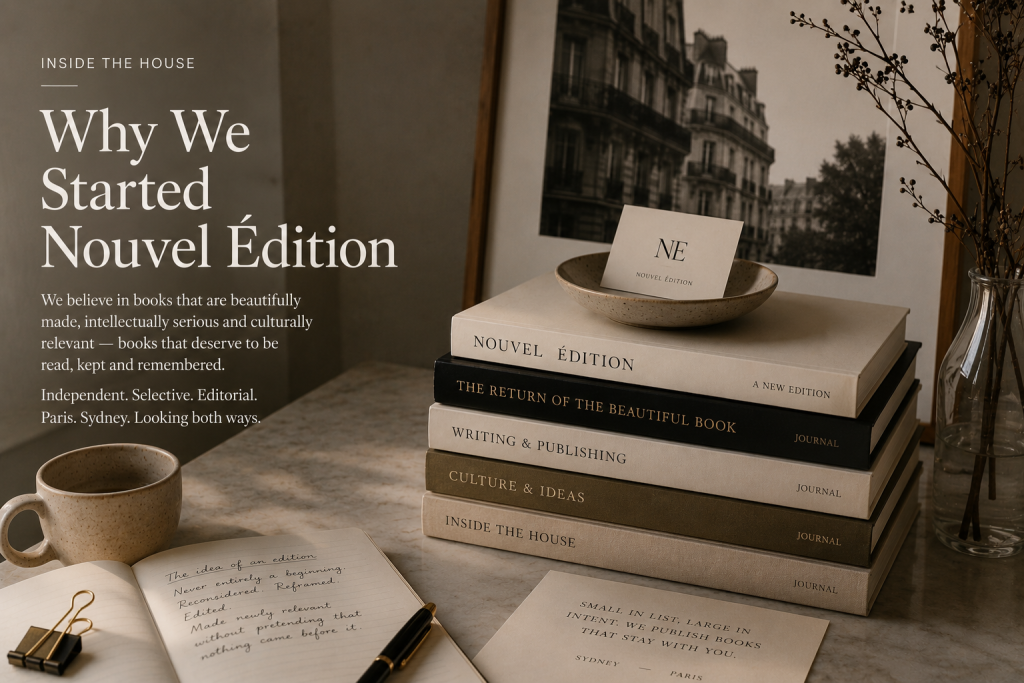
Publishing begins with a contradiction.
Books are made slowly in a culture that increasingly rewards speed.
A manuscript may take years to write. Editing asks for patience. Design depends on details many readers will never consciously notice. Printing transforms something intangible into an object that must occupy actual space in the world.
Then, once the book exists, it enters an environment built around immediacy.
New releases arrive every week. Attention moves quickly. Algorithms favour whatever is already being discussed. Publishing schedules advance before the previous season has had time to settle.
A book can spend three years becoming itself and three weeks being new.
We kept returning to that contradiction.
And to a question that eventually became Nouvel Édition:
What might a publishing house look like if it resisted some of that hurry?
Not by becoming nostalgic.
Not by pretending contemporary publishing has not changed.
But by treating books as cultural objects worth making carefully, presenting thoughtfully and allowing enough space to matter.
Nouvel Édition began there.
With the belief that publishing can still be selective.
That beauty and intellectual seriousness need not be separated.
That a small list can be an advantage.
And that the role of a publisher is not simply to release books, but to create the conditions in which particular books can be properly seen.
The idea of an edition
The name came before many of the practical details.
Nouvel Édition.
A new edition.
We liked the phrase because an edition is never entirely a beginning.
It suggests something returning in another form.
Reconsidered.
Reframed.
Edited.
Made newly relevant without pretending that nothing came before it.
That felt close to the kind of publishing house we wanted to build.
Contemporary, but interested in continuity.
Influenced by literary tradition without being governed by it.
Interested in what has endured, but equally interested in what deserves to exist next.
Publishing is already an act of choosing from possibility.
Thousands of manuscripts could become books.
Only some will.
Thousands of visual identities could surround a text.
One is selected.
Paper, typography, dimensions, imagery, positioning, language: every stage involves decisions.
An edition is the physical record of those decisions.
We wanted the house itself to operate in much the same way.
Carefully edited.
Nothing present simply because convention says it should be.
Fewer books, considered more deeply
Scale has become one of contemporary business culture’s unquestioned ambitions.
More products.
More customers.
More markets.
More output.
Publishing is not immune.
There are obvious commercial reasons for large lists, frequent releases and broad catalogues. A major publisher can support extraordinary books precisely because scale allows it to distribute risk.
But scale also changes attention.
The more titles released, the more quickly focus must move to the next one.
We were interested in the opposite possibility.
What happens when the list remains deliberately small?
A smaller list allows each book to occupy more intellectual and creative space within the house.
The question becomes not simply whether a manuscript is publishable.
Many are.
The question is whether we understand why this particular book should be published by us.
Does it belong here?
Can we add something to it?
Do we know how it should exist in the world?
Would we still want the book if nobody could tell us whether it was commercially fashionable?
These are harder questions than whether something is competent.
They are also more useful.
A publishing list eventually becomes an argument.
Each book alters the meaning of the books beside it.
Over time, patterns appear.
Certain interests recur.
A sensibility forms.
Readers begin to understand what encountering a publisher’s name on the spine might mean before they know anything about the title itself.
That kind of trust cannot be manufactured quickly.
It is built one decision at a time.
A book should feel like itself
There is an odd moment in publishing when writing becomes manufacturing.
The manuscript leaves the abstract world of language and acquires measurements.
Page size.
Paper stock.
Margins.
Spine width.
Cover finish.
Ink.
Binding.
Suddenly a sentence has a physical environment.
We are interested in that transition.
Deeply.
Not because every book needs to become an expensive object.
It does not.
Nor should design overwhelm the writing.
The most successful book design often feels inevitable precisely because it does not appear to be trying very hard.
The object simply seems to belong to the text.
That is harder to achieve than decoration.
A cover can be beautiful and still be wrong.
Typography can be elegant and still place the wrong emotional temperature around a manuscript.
A luxurious production can make an intimate book feel strangely distant.
Design should interpret.
It should recognise what the writing already knows about itself and give that knowledge physical form.
This is part of what we mean when we talk about making beautiful books.
Beauty is not an additional layer applied at the end.
It is coherence.
The feeling that the words, object and world surrounding the book belong to the same idea.
Somewhere between literature and culture
We never wanted Nouvel Édition to speak only about publishing.
Books do not exist that way in people’s lives.
A novel may lead someone toward a city.
An essay can alter the way they think about a room.
A memoir changes how they understand ambition.
A cookbook becomes attached to family history.
Photography, architecture, food, travel, art, fashion, film and literature constantly enter one another.
The cultural boundaries are more institutional than lived.
The reader who cares about the design of a book may also care about the design of a hotel.
The person drawn to an essay about memory may also be fascinated by photography.
Someone reading about Paris may begin thinking about food, painting, architecture or the strange emotional geography of cities.
We wanted room for those connections.
That is partly why this Journal exists.
Not as a publishing-company blog.
Not as an endless series of announcements about ourselves.
But as somewhere the wider sensibility of the house can develop.
Books and reading.
Writing and publishing.
Culture and ideas.
The life of the house itself.
Conversations with people whose work interests us.
Some pieces will have an obvious relationship to publishing.
Others may seem to wander.
We think wandering can be useful.
A publishing house should be curious beyond the boundaries of the books it happens to be releasing.
Otherwise the list eventually becomes an echo chamber.
The publisher as editor, not just producer
The word editorial is used so widely now that it can become almost meaningless.
An editorial photograph.
An editorial brand.
An editorial aesthetic.
For us, its most important meaning is still the simplest one:
someone has chosen.
Editing is selection.
It is also arrangement.
What remains.
What disappears.
What receives emphasis.
What is allowed to stay quiet.
A publishing house makes these decisions constantly.
The obvious version happens inside manuscripts.
But editorial judgement extends far beyond them.
Which books enter the list.
How they are described.
What their covers imply.
Which readers they are introduced to.
What conversations surround them.
Whether a manuscript is given more time rather than being rushed into production.
Even what a publisher declines becomes part of its identity.
This is why we are interested in building Nouvel Édition as a house rather than simply a mechanism for releasing titles.
A house suggests continuity.
Books enter it.
They sit beside one another.
Something accumulates.
Over years, ideally, the catalogue begins to feel less like a series of transactions and more like a body of thought.
That is the ambition.
Independent does not mean isolated
Independence is sometimes romanticised as complete autonomy.
In publishing, the opposite is closer to the truth.
Books are collaborative objects.
Writers.
Editors.
Designers.
Typesetters.
Illustrators.
Photographers.
Printers.
Booksellers.
Publicists.
Reviewers.
Readers.
A book may begin privately, but publication requires an entire network of other people to care about what happens to it.
We value independence because it gives us room to make decisions according to the work rather than a large institutional structure.
But independence is useful only if it makes collaboration more intentional.
We want writers to understand why editorial changes are being suggested.
Designers to have enough context to respond to the manuscript rather than simply decorate it.
Booksellers to understand where a title belongs.
Readers to feel there is a human point of view behind the books reaching them.
Smallness can create proximity.
That is one of its greatest advantages.
We are interested in books with a reason to exist
There are already more books in the world than anyone could read.
This is not an argument against publishing more.
It is an argument for knowing why.
A new book does not need to introduce a subject nobody has ever encountered.
Almost no book could meet that standard.
Love has been written about.
Loss has been written about.
Families, ambition, cities, desire, food, identity, memory and work have all been written about thousands of times.
Originality rarely lies in discovering a completely untouched subject.
It lies in attention.
A way of seeing something we thought we understood.
A voice we recognise as particular.
A structure that changes the material.
A perspective unavailable from another writer.
The manuscript does not need to justify literature itself.
It needs to justify this book.
Why this voice?
Why this form?
Why now?
What would be absent if it remained unpublished?
We are drawn to manuscripts that contain an answer, even when the answer is difficult to summarise.
Not everything should move faster
There is pressure in almost every creative industry to accelerate.
Publish sooner.
Post more.
Respond immediately.
Turn the work into content.
Keep the audience engaged.
Do not disappear.
There are situations where speed is useful.
There are others where it damages the thing being made.
Books often belong to the second category.
Some manuscripts need another draft.
Some need six months away from the writer.
Some need an editor willing to say that the most interesting idea has appeared halfway through the book and the beginning must be rebuilt around it.
Some covers need to be abandoned even after considerable work because they are attractive but wrong.
Some books need the courage of a quiet launch rather than an artificial attempt to manufacture a cultural event.
Time is not automatically evidence of quality.
A book can take ten years and remain unfinished.
But neither is speed neutral.
Publishing schedules shape books.
We want enough flexibility to recognise when a manuscript requires patience.
There is a difference between delay and development.
Paris, Sydney and looking both ways
Nouvel Édition is shaped by two cultural perspectives.
Paris and Sydney.
One carries an extraordinary literary and publishing inheritance. The other offers distance from inherited conventions and a certain instinct toward reinvention.
We are interested in both.
The seriousness with which books, food, art and intellectual life can occupy everyday culture in Paris.
The openness, movement and outward-looking quality of Sydney.
Tradition on one side.
Possibility on the other.
The house exists in the conversation between them rather than attempting to belong entirely to either.
That position feels useful.
Looking from one culture toward another creates perspective.
Assumptions become visible.
Things taken for granted in one place appear strange from somewhere else.
Publishing benefits from that kind of distance.
We want books people keep
There are many measures of success available to a publisher.
Sales matter.
Reviews matter.
Distribution matters.
Visibility matters.
A publishing house cannot survive on good intentions.
But there is another, less measurable ambition behind Nouvel Édition.
We want to make books people keep.
Books that remain after the initial conversation around them disappears.
Books moved from one house to another.
Books lent and requested back.
Books annotated.
Books given as gifts.
Books discovered years after publication without requiring the reader to know whether they were once considered new.
This does not mean every title must aspire to canonical permanence.
That language would be absurdly grand.
Keeping can be private.
A book may matter intensely to a few thousand people and barely register beyond them.
That is still meaningful.
Publishing has become very good at measuring reach.
It is much worse at measuring attachment.
We are interested in attachment.
A house is built slowly
Nouvel Édition is new.
There is something liberating about saying that plainly.
We do not have decades of history to point toward.
No enormous backlist.
No inherited institutional mythology.
The identity of the house has to be demonstrated rather than asserted.
Through the books.
Through the editing.
Through the design.
Through the writers we choose to work with.
Through the conversations we participate in and the ones we decide not to.
That takes time.
It should.
A publishing house becomes credible in retrospect.
Years later, someone can look across the list and see whether the stated intentions survived contact with actual decisions.
For now, we begin with a smaller promise.
To pay attention.
To publish selectively.
To treat writers seriously.
To make books whose physical form is considered part of the work.
To remain curious beyond the boundaries of publishing.
To resist unnecessary haste.
And to remember that a new edition is not valuable simply because it is new.
It has to give us a reason to see the work again.
That is where we begin.