August 2026
Why We Still Buy Physical Books
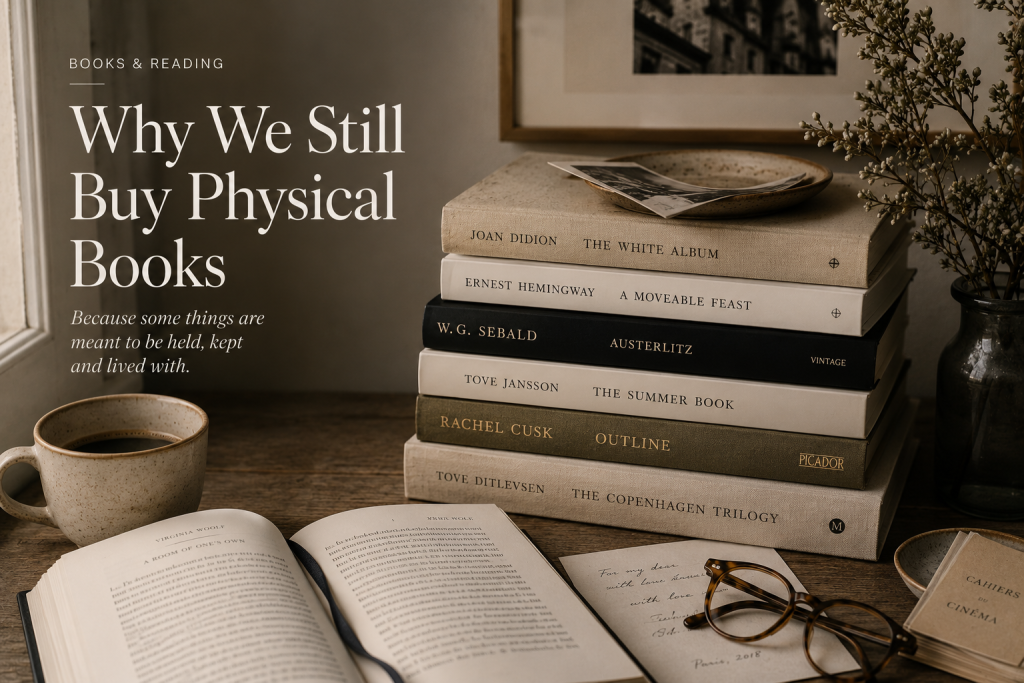
There is almost no practical reason to carry a book anymore.
A phone can hold thousands. An e-reader weighs less than a single hardback. Audiobooks can turn a walk, commute or long flight into reading time. A title can be bought in seconds, searched instantly and taken anywhere without occupying another centimetre of shelf space.
By most measures, the physical book should have become inconvenient enough to disappear.
It has not.
We still buy them.
We carry them through airports. Leave them beside beds. Stack them on coffee tables. Give them as gifts. Write our names inside them. Move them from one house to another, sometimes repeatedly, despite complaining about how heavy the boxes are.
We buy books we could borrow.
Books we could download.
Occasionally, books we have already read.
This persistence is usually explained through nostalgia. People like paper. They enjoy turning pages. They prefer the smell of books to screens.
All of that may be true.
But it seems insufficient.
Our attachment to physical books is not only sensory.
It is psychological.
A book does something unusual when it enters a home: it gives an idea a location.
And perhaps, in a culture where so much of what we consume has become invisible, temporary and endlessly replaceable, location matters more than we realised.
Access is not the same as possession
Digital culture has given us extraordinary access.
We can listen to almost any song without owning an album. Watch thousands of films without possessing a DVD. Store photographs without printing them. Read newspapers without touching paper. Keep decades of correspondence without a single letter entering a drawer.
This is enormously useful.
It has also quietly changed the meaning of ownership.
What we once possessed, we increasingly access.
The distinction can seem trivial until something disappears.
A subscription ends.
A platform removes a title.
An account is closed.
A device is replaced.
The object we thought was “ours” turns out to have belonged partly to an infrastructure we did not control.
Physical books operate differently.
Once a book enters your possession, its relationship with you becomes remarkably uncomplicated.
It does not require electricity.
It does not update.
It does not send a notification.
It does not know whether you have finished it.
It does not disappear because a licensing agreement changed.
It can sit unopened for fifteen years and remain entirely available.
There is something almost luxurious now about an object that asks so little in order to continue existing.
It waits.
That may be one of the most overlooked qualities of a personal library.
Books tolerate neglect.
They allow us to be interested in something later.
The unread book has a purpose
There is a recurring anxiety around unread books.
People apologise for them.
The books bought optimistically and never opened. The novel abandoned after sixty pages. The biography purchased because its subject seemed fascinating at the time. The stack beside the bed that somehow grows faster than it shrinks.
It can feel like evidence of failure.
But an unread book is not necessarily useless.
It represents possibility.
A library does not need to document only what we have already understood.
It can also contain the person we might become curious enough to be.
The book about architecture we have not yet read.
The collected essays waiting for the right mood.
The novel somebody recommended three years ago.
The history of a place we suddenly decide to visit.
These books create intellectual possibilities simply by remaining visible.
A digital library can contain far more titles, but its abundance tends to disappear behind the screen. Unless we deliberately open the application, the books are absent from daily life.
A physical book interrupts us.
Its spine enters our peripheral vision.
A title appears while we are searching for something else.
We remember an intention we had forgotten.
This is a quiet form of serendipity.
The shelf reminds us of ourselves.
Not only who we have been, but what we once intended to know.
A library becomes autobiographical
Ask somebody about the books on their shelves and eventually they will stop talking about literature.
They will tell you where they bought them.
Who gave them one.
Which belonged to a parent.
Which they carried through university.
Which they read after a relationship ended.
Which was purchased in a city they still miss.
Which they have moved through four houses without rereading.
Books accumulate biography.
The text remains the same, but the copy becomes specific.
That distinction is important.
There is the book, and then there is your book.
Your copy may contain a train ticket from 2014.
A former address written inside the cover.
A coffee stain.
A sentence underlined by a version of yourself who apparently believed it was extremely important.
A note in somebody else’s handwriting.
A receipt from a bookshop that no longer exists.
None of these things improves the literary work.
But they alter the object.
The book becomes partly archival.
It stores more than the author’s words.
It stores evidence of the reader who encountered them.
This is why replacing a lost book can feel strangely unsatisfying.
You can buy the same edition.
The same cover.
The same text.
And still not have the same book.
We remember where things are
There is a physical intelligence to reading that is easy to underestimate.
Readers often remember not only what they read but where they encountered it.
A sentence was near the top of a left-hand page.
A scene occurred when only a small section of the book remained in the right hand.
A particular passage appeared beneath a chapter break.
We remember the thickness of what came before and after.
This does not make print inherently superior to digital reading. Different formats support different kinds of attention.
But physical books give information spatial form.
An argument occupies pages.
A chapter has weight.
Progress can be held.
The beginning slowly transfers from one side of the body to the other.
Even the act of returning to an earlier passage involves a kind of physical memory.
We flip backward approximately.
We recognise the shape of a page before we have consciously found the words.
This relationship between reading and space may be part of why certain books feel so deeply lodged in memory.
We did not merely process them.
We moved through them.
Books make concentration visible
A physical book creates a small boundary around attention.
When someone opens one at a table, the action communicates something.
For the next few minutes, perhaps hours, their attention is elsewhere.
This sounds obvious, but the distinction has become increasingly meaningful.
A phone contains almost everything.
The novel sits beside messages, maps, news, photographs, work, banking, weather, shopping and the opinions of several million strangers.
An e-reader removes much of this competition, which is part of its appeal.
A printed book goes further.
Its function is absurdly narrow.
It contains this book.
Nothing else.
There is pleasure in that limitation.
Reading a physical book does not guarantee concentration. Minds wander regardless of format.
But the object creates conditions for it.
The page does not offer an exit.
There is no other tab.
No recommendation waiting beneath the paragraph.
No algorithm interpreting our pause as a signal to show us something else.
The book’s technological limitation becomes psychological permission.
For a while, there is only one thing to attend to.
The ceremony matters
Humans are surprisingly fond of rituals, even when we pretend to value efficiency.
Morning coffee tastes different from coffee consumed absent-mindedly in the afternoon.
Music played on a record can feel different from the same recording streamed through a phone, not necessarily because the sound is better, but because the process creates occasion.
Books have rituals too.
Choosing one from a shelf.
Packing it for a trip.
Removing a jacket.
Finding the page.
Folding into a chair.
Turning off the larger light and keeping the lamp on.
Placing the book face down, despite knowing one probably shouldn’t.
Reading one chapter before sleep.
Returning to it the next night.
These actions are not necessary for transmitting information.
That is precisely why they matter.
They separate reading from the general flow of consumption.
The book becomes an event, however small.
In a life increasingly designed around removing friction, some friction can become meaningful.
The physical book asks us to retrieve it.
Carry it.
Hold it.
Make room for it.
Perhaps ritual begins wherever efficiency ends.
Why books make unusually good gifts
Giving somebody a digital file can be useful.
Giving somebody a book feels different.
A book is one of the few gifts capable of saying several things simultaneously.
I thought you would like this.
I thought about the way you think.
I want you to encounter this idea.
This reminded me of you.
Or, sometimes: this mattered to me, and I would like it to matter to you too.
The object gives the recommendation weight.
Literally.
It can be wrapped.
Inscribed.
Placed in another person’s hands.
A digital link can convey the same intellectual recommendation, but it rarely creates the same ceremony.
Perhaps this is why books remain such resilient gifts even among people who already have too many.
A book can function as a form of personal correspondence.
The title itself becomes part of the message.
Especially when the giver writes inside it.
An inscription transforms a mass-produced object into a singular one.
The book may have been printed fifty thousand times.
This copy now belongs to a particular exchange between two people.
Years later, the inscription can become as emotionally significant as the book itself.
Sometimes more so.
A shelf is a portrait, but not a perfect one
There is something revealing about seeing another person’s books.
Not because libraries prove intelligence or seriousness.
They do not.
A shelf can be aspirational, neglected, inherited, curated for appearance or assembled almost accidentally.
But even those contradictions reveal something.
Books expose curiosity in physical form.
Cookbooks beside political histories.
Poetry beside travel guides.
A battered bestseller beside an obscure monograph.
A shelf entirely devoted to one author.
Three unfinished attempts at learning Italian.
A disproportionate number of books about gardening despite the absence of a garden.
Private libraries are interesting because they rarely make perfect sense.
Neither do people.
They show eras of attention.
A fascination that lasted two years.
A degree.
A relationship.
A career that never happened.
A country somebody once planned to move to.
A stack acquired during a period of intense optimism about how much reading could reasonably occur in a month.
There is humour in libraries.
And vulnerability.
They contain evidence of who we wanted to become alongside evidence of who we actually were.
The books we keep are not always the best books
Literary merit does not entirely determine what survives on a shelf.
Some objectively excellent books are read, admired and given away without regret.
Others remain for reasons difficult to defend.
A mediocre novel encountered at exactly the right age.
A childhood favourite that no longer holds up.
A guidebook to a place visited decades ago.
A book somebody important once recommended.
A paperback so damaged it would be easier to replace.
We keep these because libraries are not prize lists.
They are emotional systems.
Value accumulates through association.
This is one of the places where physical books separate themselves most clearly from content.
Content can be ranked.
Objects become entangled.
The physical copy participates in the life around the reading.
This is also why minimalism becomes unexpectedly complicated around books.
It is easy to ask whether an object is useful.
Harder to ask whether a book that contains a version of your past is useful.
The answer may still be no.
But the decision has changed categories.
Keeping something is an act of preference
We live in an age of almost unlimited cultural availability.
That abundance creates a new problem.
When everything can theoretically be accessed, what deserves to remain physically close?
The question extends far beyond books.
We are surrounded by more images, music, writing, products and information than any individual could meaningfully absorb.
Selection becomes increasingly important.
To choose a book for a shelf is to say, in a small way:
this one.
Not necessarily forever.
But for now.
I want this near me.
That is a different relationship from having a title stored somewhere in an account.
Physical ownership makes preference visible.
It turns taste into geography.
A few metres of shelving can contain decades of decisions.
Some deliberate.
Some inexplicable.
Together, they form a record.
The pleasure of lending and the risk of losing
Physical books also allow something digital ownership struggles to reproduce elegantly.
They travel between people.
A friend pulls a book from your shelf.
You insist they take it.
They promise to return it.
Perhaps they do.
Perhaps the book disappears into the informal economy of lending forever.
There is frustration in this.
There is also something lovely.
Books circulate through relationships.
They acquire temporary homes.
A recommendation becomes more intimate because the lender has surrendered their own copy.
Sometimes a borrowed book remains associated permanently with the person who lent it, even after it is returned.
Occasionally, an unreturned book becomes a minor monument to a friendship that also disappeared.
Libraries contain these absences too.
Gaps we remember.
The copy that should be there.
The book somebody never gave back.
This would be a ridiculous system to design deliberately.
Which may be why it feels so human.
Physical books slow obsolescence
Much of contemporary culture is organised around the new.
New release.
New episode.
New post.
New version.
New update.
The book has never entirely escaped this machinery — publishing is an industry, and industries require novelty — but physical books possess an unusual capacity to outlive their moment of promotion.
A book published thirty years ago sits on a shelf beside one published last month.
The chronology flattens.
A reader may choose either.
Used bookshops intensify this effect.
There, cultural time becomes wonderfully disordered.
A novel recently discussed online appears beside one nobody has mentioned in decades.
Outdated travel guides sit alongside forgotten memoirs and canonical works.
Publishing’s hierarchy of newness temporarily collapses.
This is one reason physical books can resist the cultural feed.
Once an object exists, it can be rediscovered independently of whether anyone is currently promoting it.
A book can wait until the culture comes back around.
Or until one reader happens to find it.
We like evidence that we have lived
Perhaps there is another reason books persist.
We like traces.
Photographs.
Letters.
Tickets.
Objects brought home from travel.
Marks on a kitchen table.
A child’s height written on a wall.
These things are not merely possessions.
They prove continuity.
Books participate in this impulse unusually well because they contain both external culture and personal history.
A shelf grows as a life grows.
Not neatly.
Books enter and leave.
Some travel through every move.
Others belong very specifically to one house.
We can sometimes date a period of our lives simply by looking at a row of spines.
There is the year we read almost nothing but memoir.
The period of obsession with food writing.
The novels bought for a university subject.
The books acquired before travelling somewhere.
The books acquired after returning.
The stack connected to a project that never happened.
A digital reading history might record this more accurately.
But accuracy is not the same as presence.
The shelf stands in the room.
It ages beside us.
The physical book is not under threat from the digital one
Perhaps the least interesting way to talk about books is to make print and digital reading compete.
They solve different problems.
An e-reader is extraordinary for travel.
An audiobook can make literature available to somebody who has no uninterrupted time to sit.
Digital texts make books searchable, portable and instantly accessible.
None of this diminishes the physical book.
In some ways it clarifies its purpose.
Once print is no longer required for every act of reading, we become more conscious of when we choose it.
The physical book does not need to win on convenience.
It probably cannot.
Its strengths are elsewhere.
Memory.
Presence.
Ritual.
Serendipity.
Ownership.
The slow construction of a private library.
Perhaps this is why physical books remain so stubbornly appealing.
They convert something abstract into something we can live beside.
A thought acquires a spine.
A story occupies three centimetres of a shelf.
An idea gains weight.
We finish reading, close the cover and place it somewhere.
Years can pass.
Then one afternoon, while looking for something entirely different, we notice it again.
The book has been there all along.
And for reasons we may not be able to explain, we are glad that it was.