August 2026
On Taste and the Things We Choose to Keep
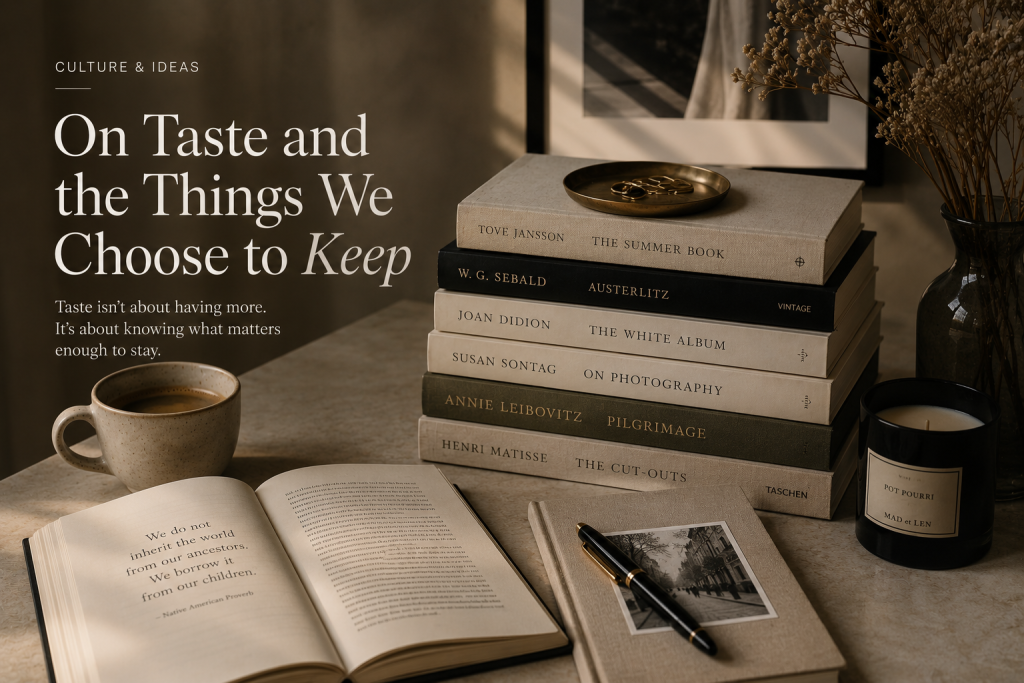
Taste is often spoken about as though it were something a person either possesses or does not.
Good taste. Bad taste. Refined taste. Questionable taste.
The language suggests a hierarchy — some invisible standard against which objects, clothes, homes, books, food and even people can be measured.
But taste is more interesting than that.
It is not simply knowing what is beautiful.
It is knowing what feels worth keeping.
The distinction matters.
We live in a culture capable of producing almost infinite choice. New objects appear faster than we can meaningfully evaluate them. Clothes, furniture, books, restaurants, images, music, opinions, places, trends and aesthetics arrive in continuous succession.
The problem is no longer access.
It is selection.
What deserves our attention?
What deserves our money?
What deserves space in our homes?
What deserves to survive the enthusiasm of the moment?
Taste begins somewhere inside those decisions.
Not as performance.
As editing.
Taste is partly subtraction
There is a tendency to associate taste with acquisition.
The beautiful chair.
The right coat.
The unusual wine.
The obscure book.
The hotel nobody else has discovered yet.
Objects become evidence.
But accumulation alone rarely produces a coherent life.
If anything, abundance makes taste harder to see.
A room containing everything a person has ever liked tells us less than one containing only what survived.
The same is true of a wardrobe.
A library.
A publishing list.
A menu.
Taste becomes clearest through exclusion.
What was left out?
What was allowed to remain?
This is why the best-designed spaces often feel less decorated than resolved.
Someone has decided where to stop.
That decision can be harder than choosing what to add.
We are trained toward acquisition because acquisition is visible.
Restraint is not.
Nobody sees the forty things you considered and rejected.
The paragraph you removed.
The photograph you did not publish.
The chair you admired but knew did not belong in the room.
The manuscript that was strong but wrong for the list.
Yet these invisible decisions shape the final result as much as anything present.
Taste often lives in what is missing.
We learn taste through attention
There is no fixed set of objects that produces good taste.
That would make taste little more than a shopping list.
Buy this lamp.
Read this writer.
Wear this label.
Order this wine.
Stay in this hotel.
The result might be expensive.
It might even be beautiful.
But it would belong to somebody else’s eye.
Taste becomes personal through attention.
We notice proportions.
Materials.
Rhythm.
The way something ages.
The way a room feels at four in the afternoon rather than how it looks in a photograph.
The weight of a book in the hand.
The difference between a restaurant that is fashionable and one that has acquired atmosphere through years of repetition.
The precise shade of white that makes one page feel warmer than another.
These distinctions can sound trivial until they accumulate.
Then they become a way of seeing.
This is why exposure matters.
The more closely we look, the more specific our preferences become.
At first we simply like old buildings.
Later we understand that what we actually like is worn stone, high ceilings, imperfect plaster and rooms where the renovations have not erased every previous life.
At first we like “classic” books.
Later we realise we are drawn particularly to novels concerned with memory, restraint and unreliable recollection.
At first we like French food.
Later we discover what we really want is a small dining room, white cloth, sharp mustard, a carafe of wine and a menu that does not require a paragraph of explanation.
Taste becomes narrower as it becomes more informed.
That narrowing is not limitation.
It is definition.
The difference between taste and trend
Trends are useful.
They give form to collective desire.
A colour returns.
A silhouette changes.
A forgotten material becomes desirable again.
A restaurant aesthetic spreads from one city to another.
A particular kind of book cover suddenly appears everywhere.
There is nothing inherently shallow about participating in this.
Culture has always moved through imitation.
The problem begins when trend is mistaken for taste.
Trends ask:
What feels current?
Taste asks:
Will I still want this when it stops feeling current?
Those questions occasionally produce the same answer.
Often they do not.
The most compelling personal environments usually contain objects from different periods without becoming nostalgic.
A contemporary chair beside an inherited table.
A new novel beside a seventy-year-old edition.
Clothes bought last month beside a coat worn for a decade.
Taste creates continuity across time.
Trend temporarily suspends it.
This does not mean everything we own should be timeless.
Timelessness itself can become a style cliché.
Some things should belong decisively to their moment.
A ridiculous pair of shoes can be worth having precisely because they will eventually date.
A brightly coloured book cover may capture a cultural mood better than something designed to look respectable forever.
Taste does not require seriousness.
It requires recognition.
Knowing when something is temporary and wanting it anyway.
We keep objects for reasons that have nothing to do with beauty
The things people keep longest are not always their most elegant possessions.
A chipped bowl.
A cheap postcard.
A watch that no longer works.
A paperback held together by tape.
A sweater with the wrong shape.
A hotel key card inexplicably left in a drawer for twelve years.
These objects survive aesthetic judgement because they have acquired another kind of value.
They contain association.
This complicates any attempt to reduce taste to visual coherence.
A perfectly designed room containing nothing emotionally inconvenient can feel strangely anonymous.
The objects that interrupt the scheme often make the life visible.
An inherited painting that does not quite match.
Children’s drawings.
Travel souvenirs.
The badly framed photograph nobody is willing to replace.
A collection of books with entirely incompatible covers.
Taste is not the elimination of sentimental attachment.
It is the ability to incorporate it without turning memory into clutter.
The distinction is subtle.
We do not need to keep everything simply because it once mattered.
Memory can survive disposal.
But some objects operate almost like physical punctuation in a life.
They mark where something happened.
Who was there.
What we once valued.
The object itself may be ordinary.
Its context is not.
Books are unusually difficult to edit
Books expose the tension between taste and attachment particularly well.
People who have no difficulty donating clothes can become strangely emotional about removing books.
Perhaps because books flatter us.
They represent not only what we own, but what we know — or hoped to know.
Giving one away can feel like abandoning a possibility.
The unread philosophy book might still be read.
The cookbook might one day become useful.
The novel we disliked was important enough to finish.
The travel guide belongs to a city we loved.
The battered childhood book is barely readable but somehow impossible to discard.
A library becomes both collection and autobiography.
This is why beautifully curated bookshelves can sometimes feel less interesting than chaotic ones.
Too much coherence makes them decorative.
Real libraries contain contradiction.
The canonical novel beside something embarrassingly popular.
The difficult work of criticism beside an airport thriller.
The volume bought solely because the cover was beautiful.
The book somebody lent and never asked to have returned.
The one inherited from a parent and never opened.
These inconsistencies are revealing.
Taste is rarely as pure in private as it appears in public.
That may be a good thing.
Objects should be allowed to age
One of the odd consequences of contemporary visual culture is that we encounter objects most often at their newest.
The uncreased leather bag.
The perfectly styled room.
The immaculate book.
The pristine table.
The garment before it has been washed fifty times.
But ownership begins where the photograph ends.
Objects wear.
Wood changes colour.
Leather softens.
Fabric fades.
Book spines crack.
Stone stains.
Silver tarnishes.
The question is not simply whether something is beautiful when new.
It is whether we can tolerate — or enjoy — what it becomes.
Some materials improve through use.
Others reveal that their beauty depended entirely on being untouched.
This is an underrated element of taste.
Choosing objects with futures.
A good table should survive dinners.
A book should survive being read.
Clothes should belong to bodies rather than hangers.
A home designed only to remain photographed has failed at being inhabited.
Wear is not always damage.
Sometimes it is evidence that the object has entered life.
The appeal of old cafés, bookshops and hotels often comes partly from this accumulation.
Surfaces have been touched enough to lose their perfection.
Nothing feels staged because too much has happened there.
Patina is simply time made visible.
Taste and money are not the same thing
Expensive things can be beautiful.
They can also be astonishingly ugly.
Cheap things can be poorly made.
They can also be perfect.
Money expands choice.
It does not automatically improve judgement.
Some of the most memorable rooms contain almost nothing of conventional value.
Books.
A table.
A lamp.
A piece of art.
Good light.
The arrangement matters more than the price.
The same is true of clothing.
Food.
Travel.
Publishing.
A lavish production budget cannot rescue a book cover with no point of view.
An expensive restaurant can feel entirely forgettable.
A small hotel can be more atmospheric than a grand one because somebody has paid attention to the right details.
Taste often appears where resources are constrained.
Limits force decisions.
A small budget requires prioritisation.
A small space requires editing.
A short menu requires confidence.
A narrow publishing list requires conviction.
Abundance allows mistakes to hide.
Restriction exposes them.
Taste becomes most interesting when it stops trying to impress
There is a particular stage in the development of taste when knowing becomes performance.
We learn the names.
The designers.
The writers.
The restaurants.
The correct references.
This is understandable.
Knowledge is exciting when newly acquired.
But eventually taste becomes quieter.
The need to prove recognition diminishes.
You can like the famous thing without apologising for its fame.
You can dislike the obscure thing despite understanding why it matters.
You stop confusing difficulty with quality.
You stop requiring every preference to be defensible.
You may know that another chair is more historically significant and still prefer the one you want to sit in.
This is where taste becomes more personal.
And often more generous.
Insecurity produces rigid hierarchies.
Confidence permits contradiction.
You can love fine dining and still want chips.
Read Woolf and a bad thriller on the same holiday.
Own something purely because it makes you laugh.
Choose beauty without pretending utility does not matter.
Taste improves when it becomes less frightened of being wrong.
The problem with collecting identity
Objects can communicate identity so efficiently that eventually we begin purchasing the identity rather than the object.
The right books suggest intellectual seriousness.
The right ceramics suggest restraint.
The right clothes suggest discernment.
The right luggage suggests movement.
The right coffee table suggests an entire imagined way of living.
Brands understand this perfectly.
They rarely sell only the product.
They sell the person who appears to own it.
This is where taste becomes vulnerable.
We begin curating ourselves for an invisible audience.
Would this photograph well?
Does this fit the aesthetic?
Is this the kind of book I want people to see me reading?
The result may be coherent.
It can also become oddly lifeless.
The most convincing taste contains things that would make little sense to anybody else.
A private obsession.
An unfashionable colour.
A strange collection.
A book reread too often.
A sentimental object.
A piece of furniture everyone else hates.
These irregularities protect a life from becoming branding.
They suggest preference rather than strategy.
Cities teach taste too
Much of what we consider personal preference is geographical.
We absorb cities.
Their materials.
Their proportions.
Their habits.
Paris can teach an appreciation for patina, repetition and things that have resisted replacement.
Tokyo can sharpen attention to packaging, precision and small-scale detail.
Sydney can make light and openness feel like materials in themselves.
London can make contradiction seem coherent.
Rome can persuade us that beauty does not require perfect maintenance.
Travel does not automatically produce better taste.
But it can destabilise certainty.
The things that seemed unquestionably correct at home become merely one solution among many.
Breakfast can look different.
A bathroom can look different.
A bookshop can look different.
A restaurant can contain almost nothing and still feel complete.
Another can contain everything and somehow work.
Exposure expands the visual vocabulary from which preference can emerge.
Then, eventually, we return to what feels like ours.
What survives the move
Moving house offers one of the clearest tests of possession.
Suddenly every object acquires weight.
Literally.
The decision to keep something now requires carrying it, packing it, transporting it and finding somewhere to place it again.
Objects that were invisible in daily life become demands.
Do I want this enough to move it?
It is an unexpectedly clarifying question.
So is travel.
Packing a suitcase compresses identity quickly.
Out of an entire wardrobe, these twenty things.
Out of a shelf, these two books.
Out of a bathroom, this small bag.
Constraint reveals preference.
Perhaps taste is most legible whenever capacity becomes limited.
A suitcase.
A shelf.
A page.
A menu.
A publishing season.
You cannot include everything.
So you choose.
The things we choose to keep
Eventually, taste becomes less about acquisition than maintenance.
The shoes repaired rather than replaced.
The books carried through another move.
The table refinished.
The coat taken to the tailor.
The recipe cooked again.
The restaurant revisited instead of trying somewhere new.
Keeping is a different kind of desire from wanting.
Wanting is immediate.
Keeping requires recurrence.
The object must continue to justify its place after novelty disappears.
This is perhaps why the things we keep reveal more about us than the things we buy.
Buying shows attraction.
Keeping shows attachment.
The difference becomes increasingly important in a culture designed to manufacture new attraction continuously.
Taste, then, may be less mysterious than we make it.
It is the gradual accumulation of attention.
We notice.
We compare.
We live with things.
We become disappointed.
We become attached.
We change our minds.
We learn what ages well.
We discover what was merely fashionable.
We understand what matters to us independently of whether anyone else approves.
And over time, a life begins to take a shape.
Not through everything we encountered.
Through what remained.
A few books.
A particular table.
Photographs.
Clothes worn into softness.
Objects carrying stories nobody else could identify by looking at them.
The things that followed us from room to room.
Taste is often described as knowing what to choose.
Perhaps its more revealing form is knowing what not to replace.