August 2026
Five Books About Reinvention
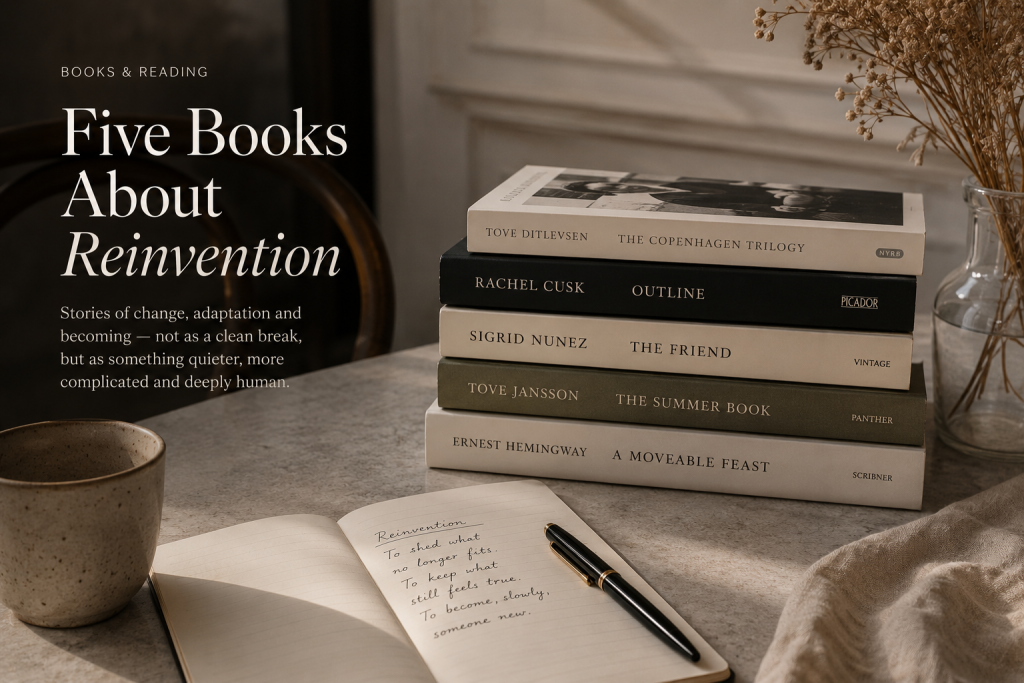
Reinvention is one of literature’s oldest subjects.
We leave. We begin again. We become someone slightly different because the person we were can no longer carry us forward.
Sometimes reinvention is chosen. Sometimes it is forced upon us by loss, failure, migration, illness, work, love or the simple fact of time passing. Often it is less dramatic than the word suggests. There is no clean break. No cinematic moment in which the old life ends and the new one begins.
More often, identity shifts slowly.
A person stops answering to one version of themselves before they are entirely sure what will replace it.
The best books about reinvention understand this.
They are not really about becoming “better”. They are about becoming altered — and about the complicated relationship between freedom and continuity. How much of the old self can be left behind? What refuses to disappear? When does reinvention become escape? When does it become survival?
These five books approach those questions from very different directions.
The Copenhagen Trilogy — Tove Ditlevsen
Tove Ditlevsen’s The Copenhagen Trilogy is ostensibly a memoir of childhood, youth and dependency.
It is also a study in how identity is assembled under pressure.
Ditlevsen grows up in a working-class neighbourhood in Copenhagen, in a home where ambition is constrained by class, gender and expectation. From an early age, writing offers a way outward.
Not necessarily escape in the romantic sense.
More like a private room inside the self.
The trilogy becomes increasingly compelling because Ditlevsen refuses the neat mythology of transformation.
Success does not liberate her.
Marriage does not settle her.
Motherhood does not resolve her.
Literary recognition does not make her invulnerable.
Every apparent reinvention carries the old life forward with it.
This is what makes the books so powerful.
They resist the idea that identity can be cleanly rewritten.
Instead, Ditlevsen shows how the self is cumulative.
Childhood remains.
Class remains.
Need remains.
Desire remains.
Even when circumstances change completely.
The result is one of the clearest literary reminders that reinvention is rarely a matter of becoming someone else.
It is more often the process of learning how to live with all the versions of yourself that came before.
Outline — Rachel Cusk
Rachel Cusk’s Outline is one of the strangest and most elegant novels of reinvention because its central character almost disappears from view.
Faye, a writer, travels to Athens to teach a writing course.
Around her, other people talk.
They describe marriages, divorces, disappointments, fantasies, resentments and self-deceptions.
Faye listens.
The novel builds a portrait of her through absence.
This is precisely what makes it such a compelling book about starting again.
Faye is recently divorced, but the book refuses the expected architecture of the “new life” narrative.
There is no declaration of independence.
No dramatic self-discovery.
No insistence that freedom must look exhilarating.
Instead, Cusk creates something quieter.
A woman temporarily stepping outside the story she once occupied.
She becomes receptive rather than declarative.
Other people’s lives pass through the novel and begin outlining the negative space around her.
The effect is unnerving.
It asks whether identity might sometimes be rebuilt not through accumulation, but subtraction.
What happens when the roles that once defined you are removed?
Partner.
Spouse.
Member of a household.
Participant in a shared narrative.
What remains?
Outline offers no sentimental answer.
Its reinvention occurs almost invisibly.
That may be why it feels so true.
The Friend — Sigrid Nunez
At the beginning of The Friend, a writer loses her close friend and mentor to suicide.
She also inherits his enormous Great Dane.
Neither event fits into her life.
Her apartment does not permit dogs. The animal is too large for the space. Grief itself seems similarly oversized, refusing to conform to the dimensions available for it.
The novel becomes a story about the strange life that emerges after a rupture.
What makes The Friend particularly interesting is its refusal to treat reinvention as ambition.
Nothing is being optimised.
No one is constructing a better self.
The narrator is simply trying to continue.
And continuation gradually changes her.
The dog rearranges her days.
Grief rearranges her memories.
The loss of her friend changes the way she thinks about writing, intimacy, loyalty and the stories people tell about one another after death.
Nunez understands that major life changes often occur indirectly.
We believe one event has happened.
Then discover, months later, that everything around it has moved.
The self changes in response.
Not because it intended to.
Because it had to.
The Summer Book — Tove Jansson
Reinvention does not always arrive in youth.
One of the pleasures of Tove Jansson’s The Summer Book is the way it places an elderly grandmother and her young granddaughter together on a small island in the Gulf of Finland.
The novel is quiet.
Almost radically so.
There are conversations, arguments, expeditions, storms, plants, animals, weather and long stretches of ordinary life.
But beneath that simplicity is a book about identity at both ends of life.
Sophia is becoming.
Her grandmother is adjusting to what can no longer be done.
Their relationship sits between those two movements.
Jansson resists sentimentality.
The grandmother is not merely wise.
The child is not merely innocent.
Both are stubborn, observant, impatient and occasionally cruel.
This complexity gives the book its emotional force.
Reinvention here is not dramatic transformation.
It is adaptation.
Learning what the body allows.
Learning how another person sees the world.
Learning when to intervene and when to withdraw.
Learning that one season of life does not need to resemble the previous one in order to remain meaningful.
The novel’s smallness becomes part of its argument.
A life can change without becoming larger.
Sometimes it becomes more exact.
A Moveable Feast — Ernest Hemingway
Paris has always carried a particular mythology of reinvention.
Arrive with little money.
Write.
Walk.
Sit in cafés.
Become an artist.
Ernest Hemingway’s A Moveable Feast helped construct much of that mythology.
But the memoir is more interesting when read with the benefit of hindsight.
Hemingway is writing about his younger self from decades away.
The young writer in Paris does not know what he will become.
The older writer does.
That creates an unusual double perspective.
The book is not simply a record of becoming.
It is a reconstruction of becoming.
Paris becomes a landscape onto which a later self projects meaning.
The cafés matter because we know what followed.
The friendships matter because many of them ended.
The hunger becomes romantic because it has survived only as memory.
This makes A Moveable Feast useful to read alongside contemporary narratives of reinvention.
We are accustomed to seeing transformation presented after the fact.
A person changes careers.
Moves countries.
Ends a relationship.
Builds something.
Travels somewhere.
Then tells the story as though the eventual outcome was visible from the beginning.
It almost never is.
Hemingway’s memoir reminds us that reinvention is easiest to narrate once it has succeeded.
Living through it is different.
At the time, it often looks like uncertainty.
The fantasy of the clean break
We like beginnings because they appear to offer control.
A new city.
A new home.
A new job.
A new relationship.
A blank notebook.
A different name.
The appeal is obvious.
The past feels fixed.
The future still seems editable.
But literature is suspicious of clean breaks.
It knows that people carry themselves into every new room.
The habits come.
The fears come.
The private hierarchies come.
The unresolved stories arrive slightly later, but they arrive.
This does not make reinvention impossible.
It makes it more interesting.
The question becomes not How do I erase the person I was?
But What do I want to bring forward?
There is agency in that.
Perhaps more agency than the fantasy of total transformation allows.
Because a life does not have to be rejected in order to be revised.
Some parts can be kept.
Some can be reconsidered.
Some can simply stop receiving so much attention.
Books are particularly good at teaching us this because characters rarely transform through intention alone.
They are acted upon.
They lose.
They encounter.
They misunderstand.
They leave.
They return.
Their identities change because their relationship with the world changes.
Ours do too.
Becoming without arriving
One of the uncomfortable truths about reinvention is that there may never be a final version.
We tend to describe identity as though it is a destination.
Eventually, we will know who we are.
Eventually, the shape of the life will settle.
Eventually, we will stop revising.
Books suggest otherwise.
The characters who remain most interesting are rarely finished.
Neither are the writers who created them.
A life moves through periods of expansion and contraction. Certainty gives way to doubt. Things once considered permanent become temporary. Old ambitions lose their charge. New interests appear without warning.
The self is constantly being edited.
Sometimes lightly.
Sometimes beyond recognition.
Perhaps this is why books about reinvention continue to matter.
They give form to an experience that is difficult to describe while it is happening.
The strange interval between identities.
The moment when the old life is no longer convincing and the next one has not yet acquired its name.
That space can feel like failure.
It can also be possibility.
The books worth returning to are often the ones that refuse to tell us which.
They simply remind us that becoming is rarely clean, rarely complete and almost never linear.
And that may be what makes it a life.