August 2026
Before You Submit: Five Questions to Ask of Your Manuscript
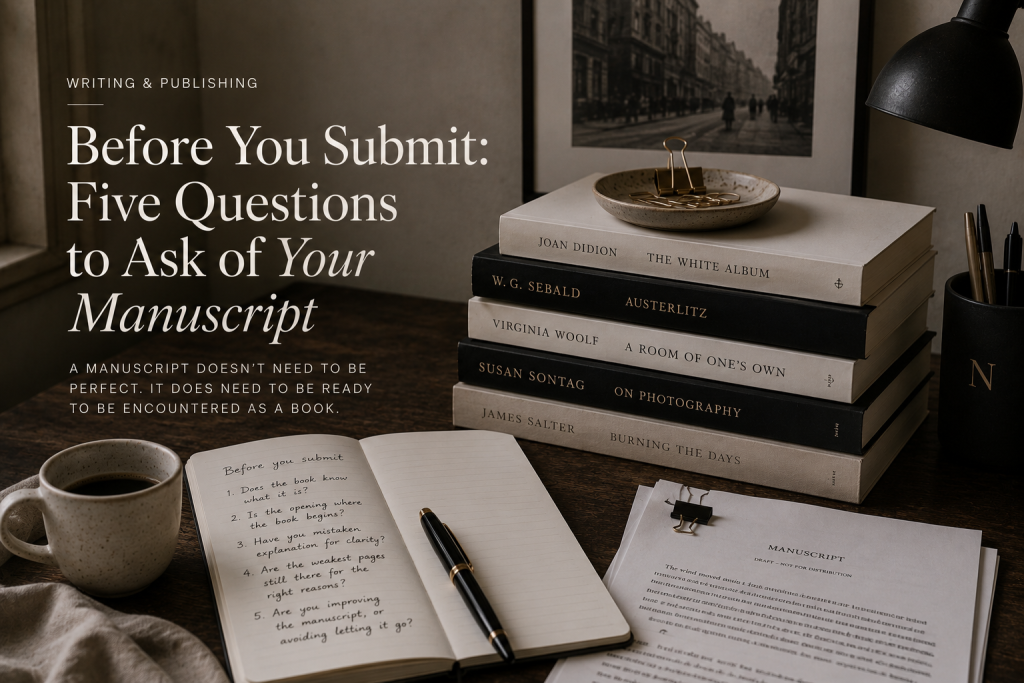
There is a point in every manuscript when the work stops feeling private.
Until then, the book has belonged almost entirely to the writer.
It has existed in notebooks, documents, fragments, abandoned openings, late-night revisions and the strange interior space where a book begins before anyone else can quite see it.
Submission changes that.
The manuscript leaves the room.
It enters another reader’s hands, another person’s judgement, another context entirely. It is no longer accompanied by the writer’s intentions, explanations or memory of how difficult a particular chapter was to produce.
It has to stand on the page.
This is why the moment before submission matters.
Not because a manuscript needs to be perfect.
It does not.
But it should be ready to be encountered as a book rather than defended as a work in progress.
The following questions are less about polishing sentences than about testing whether the manuscript has reached that point.
1. Does the book know what it is?
This sounds deceptively simple.
Many manuscripts are competently written, structurally complete and still uncertain about their own identity.
A novel may begin as a family story and gradually become a psychological study.
A memoir may appear to be about travel while its real subject is grief.
A work of nonfiction may have been conceived as an argument but ultimately become something more essayistic, intimate or cultural.
None of this is a problem.
Books often discover themselves through writing.
The problem arises when the manuscript has changed but the structure, tone or framing has not changed with it.
The result is a book pulling in two directions.
One version exists in the writer’s original intention.
Another exists on the page.
Before submitting, ask which one is stronger.
What is the book actually concerned with now?
What does it return to repeatedly?
What becomes more important as the manuscript progresses?
What would be lost if one particular thread disappeared?
The answer may not belong in a proposal, synopsis or query letter exactly as it appears in your mind.
But the writer should know it.
A manuscript does not need to state its deepest preoccupation explicitly.
It does need to be organised around it.
When a book knows what it is, decisions become easier.
A chapter belongs or it does not.
A scene earns its space or it distracts.
A beautiful paragraph either strengthens the work or reveals itself as writing left over from another version of it.
Clarity of identity is one of the most useful forms of editorial discipline.
2. Is the opening beginning where the book begins?
Writers are often loyal to openings for reasons that have very little to do with readers.
The first chapter may have been the first thing written.
It may have unlocked the rest of the manuscript.
It may contain a line the writer is particularly proud of.
It may explain information that felt necessary before the story could begin.
But the place where the writer entered the work is not always the place where the reader should.
Many manuscripts begin too early.
They clear their throats.
They establish routine before disruption.
They explain the family history before introducing the conflict.
They spend ten pages approaching the scene that contains the actual energy.
The writer needed those pages.
The book may not.
Other manuscripts begin too dramatically.
They open with an event of enormous intensity because the writer has been told to “hook” the reader, then retreat into fifty pages of context before the story catches up.
A strong opening is not necessarily the loudest moment.
It is the moment that establishes the book’s particular pressure.
A question.
An instability.
A relationship.
A voice.
A tension.
Something that makes the reader understand, however faintly, why this story begins here and not three months earlier or ten pages later.
Before submitting, try reading the opening as though you know nothing about what follows.
Does it contain the book’s real atmosphere?
Does it establish the voice the manuscript will sustain?
Does it create curiosity without manufacturing confusion?
Most importantly: does the book become more itself as the opening continues, or does it become more itself after the opening is over?
If the latter is true, the manuscript may be telling you where it actually begins.
3. Have you mistaken explanation for clarity?
Writers know too much about their own manuscripts.
They know why a character left.
They know what happened in childhood.
They know which image will return in the final chapter.
They know why a particular silence matters.
Because of this, revision often swings between two fears.
The reader will not understand.
The reader will understand too easily.
The first fear is usually louder.
So writers explain.
They clarify motivation after a scene has already revealed it.
They repeat information because they are worried the reader may have missed it.
They interpret an image immediately after presenting it.
They give characters dialogue whose real function is to communicate background.
The manuscript becomes understandable.
It also becomes flatter.
Clarity is not the same as removing every possibility of uncertainty.
A reader can be uncertain about what a character feels and still understand the scene perfectly.
They can wonder whether a narrator is reliable.
They can notice a recurring image without being told what it represents.
They can infer that a marriage is failing before either character admits it.
This interpretive space is part of reading.
Before submission, look particularly carefully at sentences that explain the sentence before them.
Paragraphs beginning with phrases such as “what she meant was” or “in other words” deserve attention.
So do emotional labels that appear after behaviour has already made the emotion visible.
Sometimes the clearer version of a manuscript is the one that says less.
Not because withholding automatically creates sophistication.
Because readers need room to participate.
4. Are the weakest pages still there because they are necessary, or because they were difficult to write?
Not all attachment to a manuscript is aesthetic.
Some of it is emotional.
A chapter required months of research.
A scene was rewritten twelve times.
A passage came from a real experience that mattered deeply.
A character existed before the rest of the novel.
A section contains facts too interesting to waste.
The effort invested in writing can make material feel valuable even when it no longer serves the book.
This is one of the hardest forms of editorial blindness.
We tend to confuse cost with necessity.
But the reader has no access to the labour behind the page.
They do not know that a paragraph took three days.
They know only whether it works.
Before submitting, identify the parts of the manuscript you are most reluctant to question.
Not the parts you love.
The parts you defend.
There is a difference.
When criticism reaches those pages, does your first instinct become explanation?
Do you find yourself saying, “Yes, but you need this because later…”?
Do you rely on context outside the manuscript to justify it?
Sometimes the answer will be that the section genuinely is necessary and the reader simply did not understand its function.
That is useful information too.
Perhaps the function needs to become clearer.
But sometimes the defensive response is evidence that the book has moved on and the writer has not.
A manuscript often becomes ready when the writer can distinguish between preserving the work and preserving the effort that went into it.
5. Are you still improving the manuscript, or are you avoiding letting it go?
There is always another edit.
This is one of the most dangerous truths about writing.
Almost any paragraph can be altered indefinitely.
A sentence can become shorter, then longer, then return almost exactly to where it began.
An opening can be rearranged five times without becoming meaningfully better.
Words can be replaced by equally good words.
One chapter can move forward, then backward, then forward again.
At some point revision stops being developmental.
It becomes circular.
Writers often recognise this intellectually long before they recognise it emotionally.
Submission involves risk.
Another person may not like the manuscript.
They may misunderstand it.
They may decline it quickly.
They may identify a weakness the writer secretly already knows exists.
As long as the manuscript remains unfinished, rejection can be postponed.
There is always another version to protect.
Perfectionism is useful camouflage for fear because it sounds like seriousness.
Sometimes it is seriousness.
A manuscript may genuinely need another six months.
But sometimes “not ready” means something else.
Not safe.
Not guaranteed.
Not beyond criticism.
No manuscript ever reaches those conditions.
The more useful question is whether revision is still changing the work.
Are the characters becoming more coherent?
Is the argument becoming sharper?
Is the structure improving?
Are scenes gaining tension?
Is the voice becoming more precise?
If yes, keep going.
If the changes are increasingly lateral, the manuscript may already be telling you something.
Finished does not mean incapable of further improvement.
Published books are not perfect books.
They are books that reached a point of sufficient clarity, coherence and vitality to enter conversation with other readers.
The manuscript after you
There is another question beneath all five.
Can the manuscript exist without you beside it?
A writer can always explain why something matters.
The manuscript cannot.
It cannot tell an editor that chapter seven will make sense after a conversation about the author’s childhood.
It cannot reassure a reader that the confusing opening becomes much stronger later.
It cannot explain that the character is deliberately unlikeable.
All of that understanding has to be contained within the work.
This does not mean everything must be obvious.
It means everything essential must be available.
There is a difference.
A manuscript ready for submission has begun to acquire independence from its writer.
The book can be interpreted in ways the author did not expect and remain intact.
Its ambiguities feel purposeful.
Its silences have shape.
Its voice does not depend on explanation.
Its structure holds.
It becomes possible for someone else to enter it without being shown around.
That independence can feel strange.
For months or years, the writer has known the book more intimately than anyone else.
Then the manuscript reaches a point at which another reader may understand something about it the writer does not.
This is not a loss of ownership.
It is the beginning of literature.
Before pressing send
The final stage before submission does not require dramatic revision.
Often it requires stillness.
Read the first pages again.
Read the last pages.
Read the chapter you are least certain about.
Look at the book as a whole.
Ask whether the version in front of you is the version you intend to be judged.
Not whether it represents every possibility the book might ever have had.
Not whether every sentence is beyond improvement.
Simply whether the manuscript now carries the work you set out to do — including the parts of that work you discovered only by writing it.
Then stop.
Prepare the submission carefully.
Follow the guidelines.
Send what has been requested.
And allow the manuscript to enter a room you cannot accompany it into.
That is part of writing too.
There is a moment when the work must stop belonging exclusively to the person who made it.
Submission is not proof that a manuscript is perfect.
It is the writer deciding that the book is ready to be read.